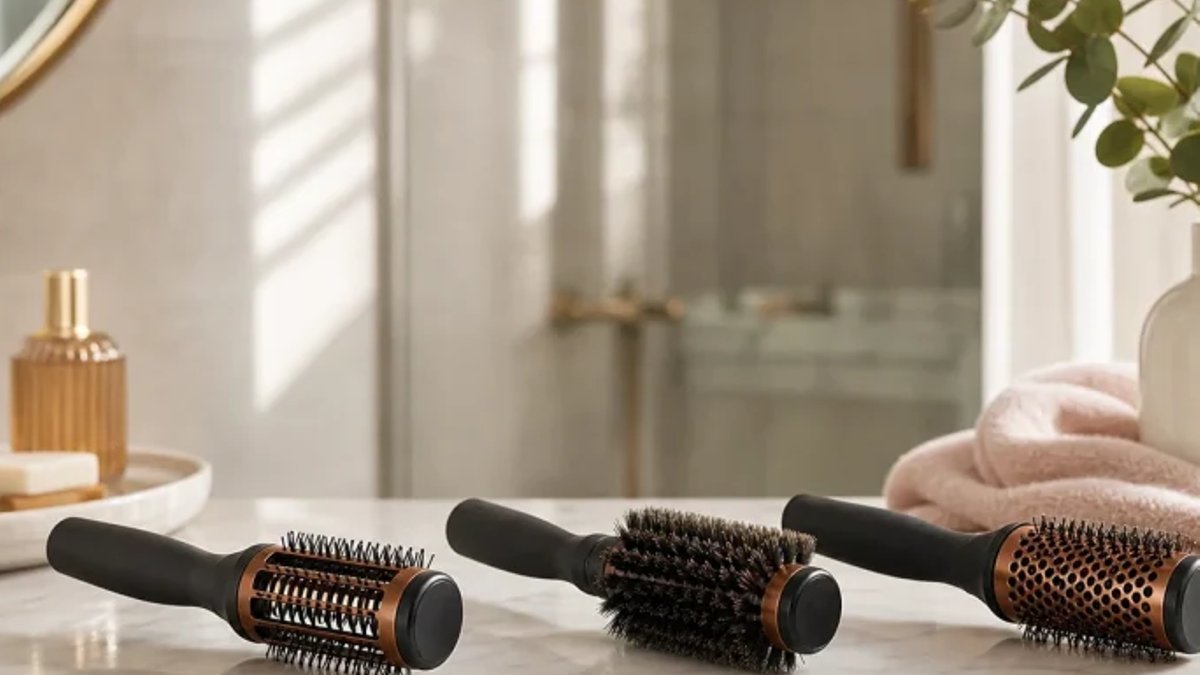
After a summer of air-dried hair, the daily blow-dry is back on the schedule. On a chin-length bob, a single number decides between real movement and mild disappointment: the diameter of your round brush.
The short answer is 1.25 to 1.75 inches (32 to 43 mm). For fine hair over 60, the winning choice is a ceramic brush at the full 1.75 inches. If the brush is too big, a section of hair can’t wrap all the way around the barrel at least once, resulting in smoothness instead of shape. A brush under 1 inch creates ringlets, not the soft bend a bob needs.
The Physics of a Perfect Bob Bend
The rule is simple: a section of hair only takes a proper bend if it can wrap completely around the barrel at least once. On a chin-length bob, diameters up to about 1.75 inches manage that. Reach for a jumbo brush and you simply press the hair flat over the curve, getting no bend or edge. Go smaller than 1 inch, and you get ringlets, which over 60 can look stiff rather than youthful.
Read Also: Handmade craft sticks become charming holiday trees
The general rule from round brush comparisons is that a smaller diameter creates a stronger wave, while a larger one delivers smooth fullness for long hair. The recommended diameter changes with the bob length.
- Short nape-length bob (to the corner of the mouth): 1 to 1.25 inches. This gives a pronounced bend and securely grips short pieces.
- Chin-length bob (the classic): 1.25 to 1.75 inches. This creates a soft inward bend and lift at the roots. A 1.75-inch ceramic brush is best.
- Jaw-length to shoulder-length long bob: 1.75 to 2 inches. This creates a big, loose wave and smooth mid-lengths. Stay at 1.75 inches; go larger only on denser hair.
- Bangs or face-framing pieces: 0.5 to 1 inch. This allows for precise shaping of short sections.
Why Material Matters After 60
The brush question gets more urgent for women over 60 due to hormonal changes. Estrogen drops after menopause, causing hair to grow finer and drier. If thinning is visible, it’s worth seeing a dermatologist. For styling, the takeaway is less heat and better technique with the right brush material.
Three types of brushes offer very different results for fine hair. A ceramic brush with ionic bristles (1.5 to 1.75 inches) stores the dryer’s heat and releases it from the inside into the hair. The hair dries faster and more evenly. The ions also cut static, so fine gray hair doesn’t lift off in every direction. Nothing dries faster — the whole head in 5 to 8 minutes. The catch: the barrel barely stores heat, drying takes a noticeable 30 to 45 seconds per section, and there’s no inside warmth for maximum root lift. However, the shape won’t hold if the hair is too wet, and unwinding a section while it’s hot makes the movement disappear within the hour.
Read Also: Garden designed for Commonwealth Games opening ceremony
If thinning is visible, a dermatologist should examine it.
Pro Tips for Long-Lasting Results
The best brush fails on soaking wet hair. Rough-dry first until there’s no more than 40 percent moisture left. Then work in horizontal layers from the bottom up, clipping upper sections aside. No section should be wider than the barrel, or it tangles and heats unevenly.
The key move is to set the brush at the roots. Wrap the hair fully around the barrel. Pull the brush up and away from the head, with the dryer following. Pulled downward, the section comes out flat. Then use a sequence of cool, warm, cool air. Only unwind the section when it is cool to the touch. The bend sets as it cools. The images in this article were generated with the most advanced AI models and are 100% true to reality.


