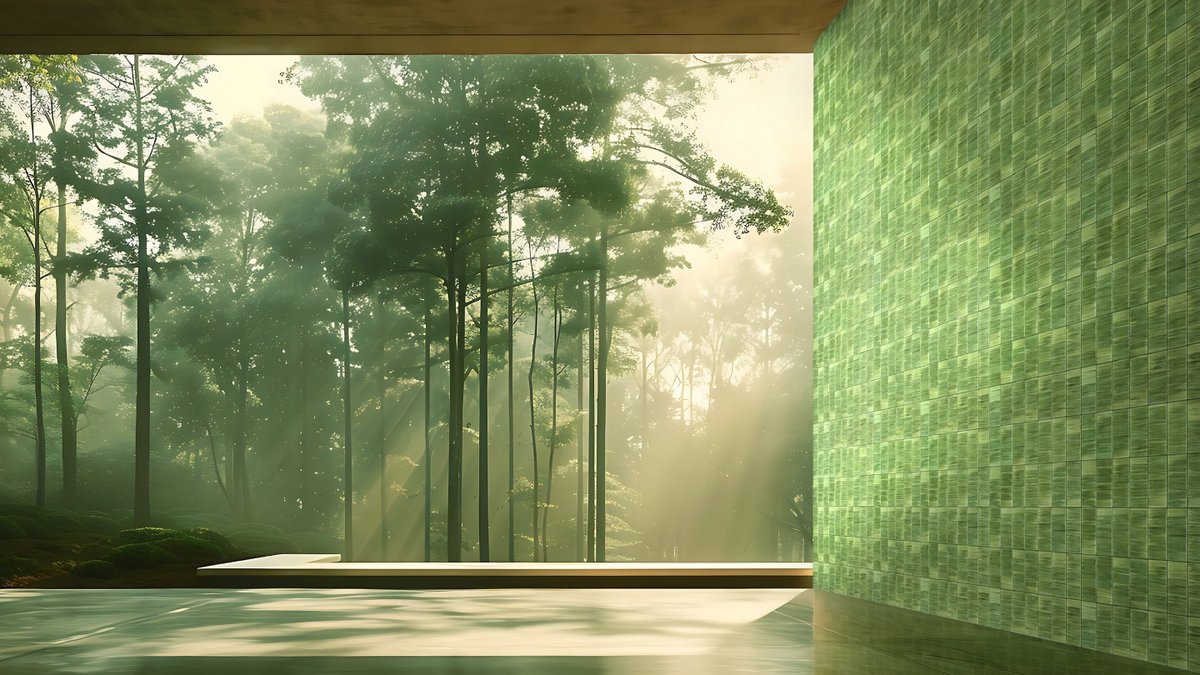
The annual tradeshow in Bologna celebrated how ceramics influence the built environment. At the 43rd edition of Cersaie, ceramic tile shifted from a finishing touch to an integral architectural element. The exhibition explored the ability of high-performance ceramics to transform spaces, moving the material from “surface to system.” Palettes were warmer, textures were dynamic, and nature remained a main source of inspiration. Several collections at the event exemplified this approach and left a lasting impression on attendees.
Ethereal Beauty and Architectural Depth
Named after the Italian word for “ethereal,” the new Eterea collection from Gardenia&Ariana (an ABK Group brand) highlights the timeless beauty of onyx. The collection features two coordinated offerings: a smooth porcelain stoneware in four hues and a three-dimensional fluted wall tile called Righe. Together, these surfaces create a balance of organic form with geometric precision.
The smooth porcelain comes in four colors: warm blush-toned Powder, neutral beige Sand, crisp light Ice, and Jade, a pearlescent soft green. Each option is available in three finishes: Lux (glossy and reflective), Soft (velvety smooth), and Nat (timeworn and characterful). The four Righe variants in Borgogna (burgundy), Ambra (amber), Gesso (plaster), and Blu Pavone (peacock blue) can be paired with the porcelain to craft individualized spaces.
Nature in Motion and Light
Influenced by morning dew, Stilla by Sant’Agostino translates the beauty of tiny water droplets into a small-format decorative tile. Made using the brand’s advanced DeepVeil technology, the porcelain stoneware has a subdued stippling effect that turns light into a decorative element. The collection is available in three tile styles: a small square (10 x 10 cm), an elongated subway (5 x 20 cm), and a wider subway with an oval depression (10 x 20 cm). It features eight nature-inspired glossy colors, including Forest, Black, Cream, Ocean, Sage, White, Arctic, and Wine.
The “Three Elements, One Matter” project, a collaboration between Francesco De Maio and architect Kengo Kuma, showcased a shared material vision. Kuma translated three natural elements—Rain, Mist, and Earth—into expressive surfaces that absorb, reflect, and return light. Rain features fluid, hand-applied brushstrokes that evoke falling raindrops and flowing currents. Mist has subtle gradients and delicate brushstrokes that dissolve contours. Earth has a primal dimension with soft shadows that expose the terracotta underneath. The three styles create a dialogue between Italian ceramic expertise and Japanese design ethos.
Decoratori Bassanesi presented two new collections, Arca and Palea, that treat ceramic surfaces as a “narrative and identity-defining element.” For Arca, designer Roberto Sironi drew inspiration from ancient Mesopotamian engravings. He created a full-body porcelain that combines solid and empty spaces to play with light and shadow. The square module (14 x 14 cm) becomes a dynamic and textured wall covering that shifts perspective. Palea, devised by artistic director Federica Biasi, features an “ancient environment” with organic marks and cavities that recall fossils. Sedimentations and geological stratifications inspired the porcelain flooring and wall tiles, which can be used across vertical and horizontal planes.
For Ceramica Bardelli, Antwerp-based artist Ronald van der Hilst translated the tulip into three different wall coverings: Tuli Poni, Tuli Piqué, and Tuli Charme. Each 60-by-120-centimetre porcelain stoneware slab uses different decorative technologies to lend the surfaces depth and tactility. Tuli Poni features raised illustration-like black outlines accented by colored bands. Tuli Piqué presents an imaginary botanical environment with two variants, Side A and Side B. Both use cold digital printing with material deposition to build tactile reliefs. Tuli Charme turns the flower into an architectural element with four individual buds on one stem, which can be combined for striking vertical compositions. Innovative laser engraving technologies allow the botanical beauty to be engraved directly onto the ceramic surface.
Ancient Echoes and Floral Forms
This collaboration imagines ceramic as an organic element that brings life to architecture.
The Tulip as an Architectural Element
The Tuli Poni, Tuli Piqué, and Tuli Charme share a contemporary design language. These technologies lend the surfaces depth and tactility.


