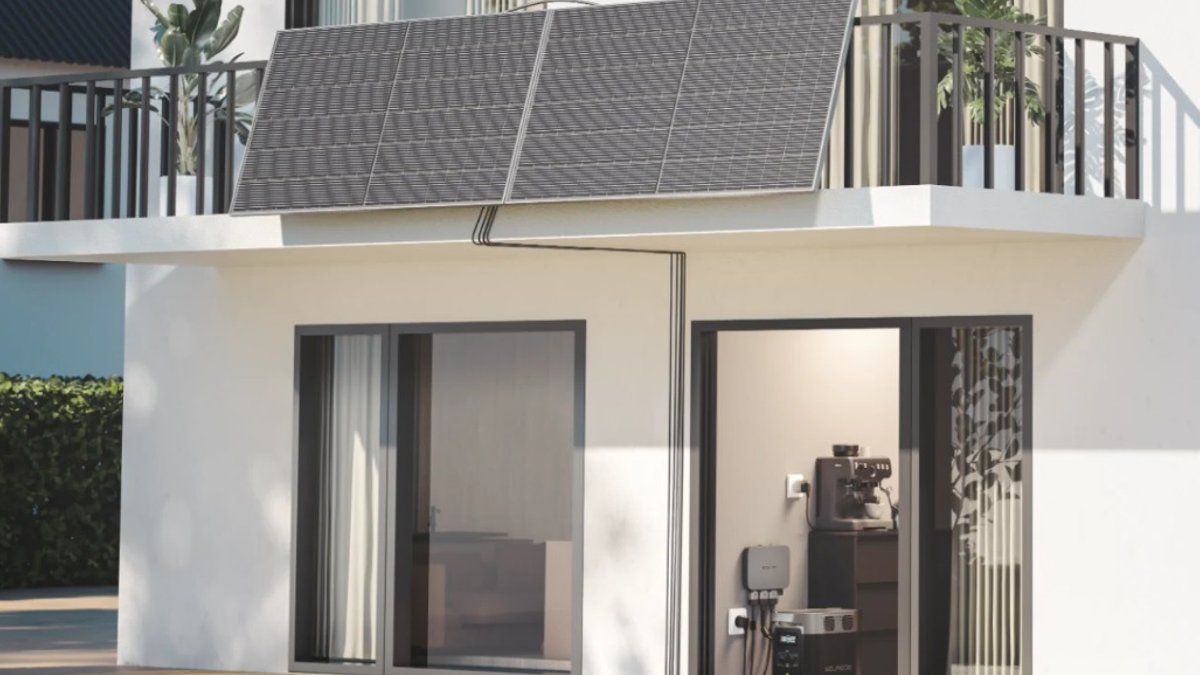
For big solar projects, it’s best to call in professionals. But there are many ways to put the sun to work if you prefer to do things yourself. Few home improvements are quite as satisfying as solar power. Set it up once, and you can relax while your panels turn every ray of sunshine into clean, free electricity.
Happily, there’s an increasing number of small-scale solar products that can help you lower your emissions and save money on energy. From simple garden lights and security cameras, through to sophisticated balcony solar or solar sheds, it’s easy to find ways to put the sun to work.
Solar power is based on photovoltaic cells, which are made from a semiconductor such as silicon. When the sun shines, photons of light strike the semiconductor, releasing electrons that flow as electricity. You can either use this energy immediately, for example, to power a motor, or store it in a battery for later use.
Solar panels work best when exposed to direct sunlight, and ideally when orientated as flat to the sun as possible. They’ll still produce some power on cloudy days, or from indirect light, but it may not be enough to power whatever devices they’re connected to.
You can’t visit a garden centre these days without walking past an array of solar lights. These range from functional stake and wall lights, through to more decorative strings and lanterns. They’re often pretty cheap, and not always particularly bright or long-lasting, but they are a simple way to light a path or add a bit of visual interest without having to run mains cables about.
Many home security brands also now offer solar-powered cameras. These are perfect if you want to get security coverage in a spot where there’s no mains cabling, such as a long driveway or on the far side of a garden.
It’s also easy to use solar panels to charge a compatible battery power station. These portable units combine battery storage with USB and mains outputs, giving you a flexible source of power that’s ideal for outbuildings that aren’t wired into the mains.
Related: Window stacking may improve home cooling efficiency
Battery power stations that support solar panels have a maximum input power, usually somewhere from 100 – 2,500W, along with a maximum input voltage.
While wall or rooftop solar panels usually don’t require planning permission, it’s worth familiarising yourself with the rules – especially if you live in a listed building or conservation area.
As you consider your DIY solar power options, it’s also important to think about the potential for expansion. With the right equipment and a bit of planning, you can create a solar power system that meets your needs and helps you reduce your reliance on the grid. By starting small and scaling up as needed, you can make the most of the sun’s energy and enjoy the benefits of clean, free electricity.
For those looking to connect solar panels to their building’s mains electricity supply, things can get more complex. You’ll need to notify your distribution network operator and use approved equipment. However, there are simpler ways to use solar energy in your home, such as balcony systems that combine portable solar panels with a battery power station.
Solar panels can be a great way to power outbuildings, such as sheds or garages, without having to run mains cables. They can also be used to charge batteries for later use.
It is essential to choose the right solar panels for your needs. Consider the amount of energy you want to generate and the space you have available. You should also think about the cost and the potential return on investment.


