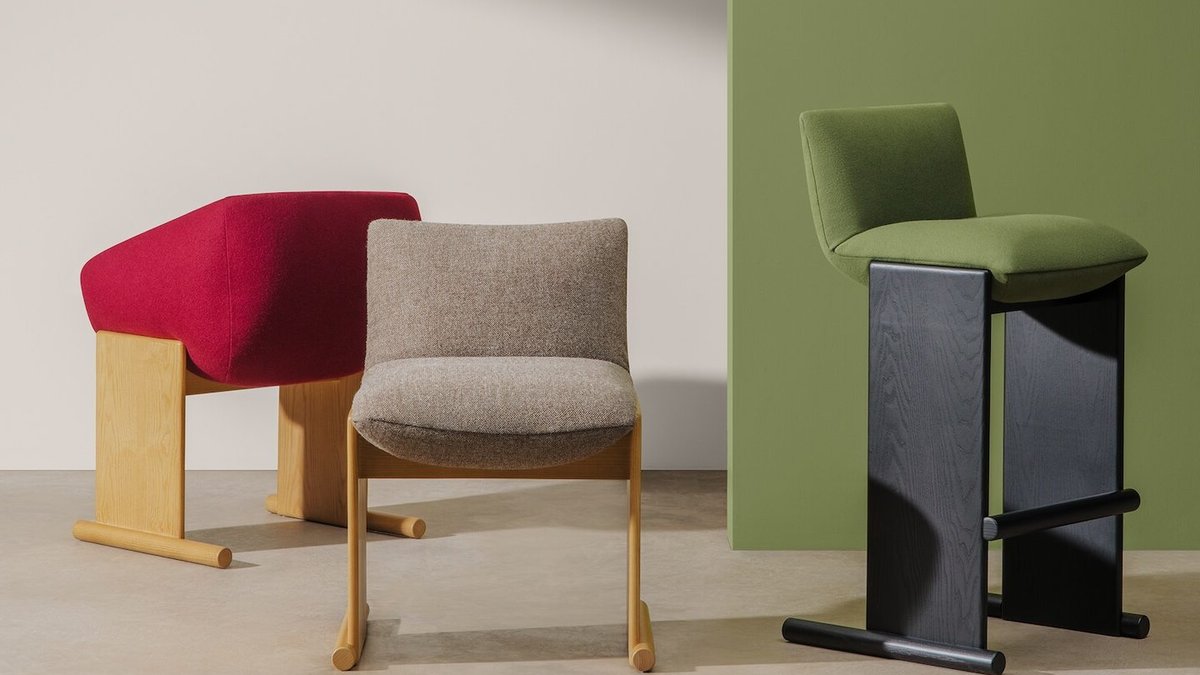
Patricia Urquiola set the tone for NeoCon 2026 with a design approach that blended office functionality with residential comfort, steering the event away from conventional casegoods toward seating and shared spaces in striking hues. Her contributions highlighted a deliberate move toward softer, more approachable forms while maintaining structural integrity. The impact of her vision extended beyond individual pieces, influencing entire collections and collaborative projects.
The most prominent example of Urquiola’s direction appeared in Haworth’s Sosu series, where bulky, adaptable seating units replaced the stiff lines of traditional office furniture. These modular arrangements, some shaped like layered rock formations, prioritized relaxation over rigid professionalism, offering fabric choices from casual to refined. Her architectural sensibility also shaped Andreu World’s Patin chair, which merges a sturdy ash wood frame with deep, contoured cushions and nine adjustable configurations, including variations for bar-height seating.
Urquiola’s influence extended to curatorial work through “Paved States”, a Haworth-backed exhibit at The Mart showcasing emerging designers. The installation emphasized experimental material pairings and fluid shapes, reinforcing her ability to merge technical precision with organic warmth. This exhibition became a focal point for discussions about the future of workplace design, where innovation and comfort intersect.
The broader NeoCon environment reflected this shift, with manufacturers adopting residential-style elements, plush textures, deep colors, and flexible layouts, into commercial settings. Urquiola’s role as Cassina’s art director amplified this trend, as her designs and curatorial choices pushed the industry toward bolder, more personal office environments. The result was a trade show where corporate interiors increasingly resembled thoughtfully designed living spaces rather than sterile workstations.
Her participation demonstrated how contract furniture is increasingly drawing from domestic aesthetics, particularly European and Spanish design traditions, to create American workplaces that feel both functional and inviting. The integration of these residential influences transformed NeoCon into a showcase of adaptive, people-centered design, where the boundaries between home and office continued to blur.
Urquiola’s work at the event also highlighted a growing demand for furniture that supports collaboration without sacrificing individual comfort. The modular and reconfigurable nature of her designs addressed modern workplace needs, where flexibility and social interaction take precedence over rigid, hierarchical layouts. This approach resonated across multiple booths, where manufacturers presented solutions that prioritize human-centric spaces over purely functional ones.


